Showing posts with label I-864 Affidavit of Support. Show all posts

How to Assemble My I-485 Adjustment of Status Package - Updated April 2024!

Purchase Your Assembling Guide Here for $10! (10 Steps to Assemble your I-485 AOS Application Package)


How to organize my I-485 concurrent filing
I don't think there's a right or wrong way of organizing the I-485 package. It all depends on how you want the agent to review your case. I separated my package into 3 papers on top, 7 folders and 1 sealed envelope. Here's my filing order for your reference:
  1. Four G-1450 Forms (on top) - Authorization for Credit Card Transactions for I-485, I-130, I-131 & I-765
  2. Main Cover Letter
  3. I-485 Folder - Adjustment of Status
  4. I-864 Folder - Affidavit of Support
  5. I-944 Folder - Declaration of Self-Sufficiency
  6. I-130 Folder - Petition for Alien Relative & I-130A Supplementary Information for Spouse Beneficiary
  7. Evidence of Bona-Fide Marriage Folder
  8. I-765 Folder - Application for Employment Authorization
  9. I-131 Folder - Application for Travel Document
  10. Sealed I-693 Envelope - Report of Medical Examination & Vaccination Record

How to assemble my I-485 concurrent filing package

On the USCIS website, there are some guidelines you can follow:
  • Use black ink
  • Do not use highlighter or correction fluid/tape
  • Do not use binders or folders that cannot be easily disassembled
  • Make sure you have written "Original Submission" on the package and the main cover letter. 
  • Add tabs at the bottom, not on the side
  • Two-hole punching on top is appreciated - This is not required and I wasn't sure about the hole distance, so I decided to skip the hole punching


More related questions:


Disclaimer: This article is for sharing my personal experience only and not for the purpose of providing legal advice.

Watch Out: USCIS Flexibility Periods for RFE Extended to Jan. 24, 2023!

Remember that during COVID-19 pandemic, USCIS extended certain flexibilities to assist applicants? No these flexibility periods have come to an end!

Watch Out: USCIS Flexibility Periods for RFE Extended to Jan. 24, 2023!

What was the flexibility timeframe set by USCIS?

March 1, 2020 to July 25, 2022.

1/3/2023 Updated: USCIS continues to extend certain COVID-19 related flexibilities through Jan. 24, 2023!

How does it affect my application?

Currently, USCIS will still accept responses received within 60 calendar days after the due date set in the following requests or notices (only if the date listed on the notice is between March 1, 2020 and July 25, 2022 Jan. 24, 2023) So be sure to check your date on the notice! This applies to the following notices:

  • RFE Requests for Evidence
  • Continuations to Request Evidence (N-14)
  • Notices of Intent to Deny
  • Notices of Intent to Revoke
  • Notices of Intent to Rescind
  • Notices of Intent to Terminate Regional Centers
  • Motions to Reopen an N-400 Pursuant to 8 C.F.R. 335.5, Receipt of Derogatory Information After Grant
Read more new posts:

USCIS Released the New Versions of Several Forms

USCIS released the new versions of several forms! If you are submitting your application after April 7th, 2022, be sure to use the latest version from USCIS's website. Here's a quick list for your convenience:

USCIS Released the New Versions of Several Forms

USCIS Released the New Versions of Several Forms

What USCIS forms are updated?

What is the cutoff date?

April 7th, 2022! Starting from April 7th, you can't use any older versions of these forms, otherwise your application can be rejected. It's always good to double check before you submit your application!

Read more USCIS news updates:

USCIS Now Accepts Credit Cards for Most Form Fling Fees!

Did you know? USCIS announced that they will begin accepting credit card payments for most of the form filing fees!

You may have heard of USCIS's credit card payment pilot program and now finally they are accepting this newest payment option. 

USCIS Now Accepts Credit Cards for Most Form Fling Fees!

How do I pay USCIS fees by credit card?

You will have to attach Form G-1450, Authorization for Credit Card Transactions. 

What forms are accepting credit card payments?

Nearly all form filing fees! Although, you have to know that Form I-129 is an exception. I-129 is for petition for a nonimmigrant worker for H-1B and H-2A visas.

At the end of the pilot period, USCIS will evaluate and announce the next steps for opening up this new payment option for other forms. Stay tuned!

More USCIS News:


3 Latest USCIS Policy Updates that Affect Your Green Card Application

Great news! U.S. Citizenship and Immigration Services (USCIS) issued new updates in the Policy Manual to improve immigration services and process. There are three main areas to update. Let's check out what this is all about!

3 Latest USCIS Policy Updates that Affect Your Green Card Application

USCIS Issues New Policy Updates for Better Immigration Services

1) USCIS Begins to Issue an Requests for Evidence and (RFE) Notices of Intent to Deny (NOID) Again

Remember the new rule about denying applications without issuing an RFE? USCIS is going back to the old rules now!

USCIS will be issuing an RFE or NOID when additional evidence could potentially demonstrate eligibility for an immigration benefit. 

What does this mean? This updated policy will give applicants a chance to correct innocent mistakes and unintentional omissions.

2) Two-year Employment Authorization Documents (EAD)

To ease the problem of ongoing processing delays, USCIS will now increase the one-year validity period on both initial and renewal EADs to two years for certain adjustment of status (AOS) applicants. 

3) Warranted Expedited Processing

USCIS officers are provided guidance on when expedited processing may be warranted. Also, nonprofit organizations may request a benefit for expedited processing even if premium processing is available for that benefit. 

There you go! Don't forget to also check out:

USCIS Withdraws Affidavit of Support Proposed Rule

Did you hear this great news? The Department of Homeland Security today announced that they will withdraw the affidavit of support proposed rule. This is to reduce barriers within the legal immigration system.

USCIS Withdraws Affidavit of Support Proposed Rule

Download Green Card Application Cover Letter Templates Here

What is Affidavit of Support Proposed Rule?

This proposed rule would have imposed higher qualifying and evidentiary requirements. This includes tax returns, banking information, credit reports and more. This could have placed costly burdens, estimated at $2.4 billion over the next decade, on US citizens and lawful permanent residents who sign an affidavit of support on behalf of intending immigrants. The rule was proposed on October 2nd, 2020.

Now that this proposed Affidavit of Support rule is withdrawn, it will be so much less work for people who need to sign an affidavit of support for their family members and/or other intending immigrants. 

Read USCIS's post to learn more details. 

USCIS Announced New SAVE Initiative to Hold Sponsors Accountable

Have you heard SAVE? SAVE is short for Systematic Alien Verification for Entitlements, it is USCIS's new system that will ensure more effective compliance with federal laws and regulation related to financial support of aliens by their sponsors and agency reimbursement. 

USCIS Announced New SAVE Initiative to Hold Sponsors Accountable

In short words - USCIS will now more strictly holding sponsors of aliens legally accountable for the financial responsibilities they willingly accept.

How Does the New SAVE Feature Affect Green Card Applicants?

A couple things you may need to know about:

1) SAVE gives additional information to hold sponsors accountable

SAVE provides information about sponsors to agencies that evaluate public benefits. USCIS will be asking these agencies to share how they use the SAVE sponsorship information in their sponsor assessment and agency reimbursement processes. This additional information will help the agencies learn and determine eligibility and hold sponsors accountable. 

In the future, when the sponsored aliens apply for means-tested public benefits from federal, state, local, or tribal agencies, their eligibility will be evaluated to determine if the sponsor's income and resources could disqualify these aliens. If a sponsored alien already inaccurately received a means-tested public benefit, an agency can also request an reimbursement from the accountable sponsor or seek a court order for repayments.

2) Save will be part of your Public Charge Evaluation: 

The SAVE feature will support agencies as they determine an alien's eligibility for public assistance by ensuring and established sponsorship requirements and proper accountability.

Visit USCIS's website to learn more information!

Keep reading..

How Many Years of Tax Return Do I Need to Provide for Form I-864?

Tax return information is one of most important supporting item to provide for Form I-864 Affidavit of Support. This will prove your income source, tax return history and your sponsor's financial status. Let's hear some of my readers' frequently asked questions and answers:

Click Here to See Form I-864 Checklist

How Many Years of Tax Return Do I Need to Provide for Form I-864?

Form I-864 Frequently Asked Questions

Q: Do I need to provide 3 recent years of the tax returns? Or just the recent year tax return.

A: The most recent year tax return is 100% required! Optionally, you can also provide the recent three years of tax return documents if you believe this will help you prove your ability to maintain sufficient financial status. 

If you can't meet the income requirement, you can consider adding assets, read this post to learn more: How to include assets for Form I-864

Q: How do I get tax return transcripts from the IRS?

A: You can request from IRS's website: https://www.irs.gov/individuals/get-transcript

There are two options, request the transcripts by mail or online.

Q: I can't get the transcripts in time, can I just provide my tax forms?

A: In Form I-864 instruction, it states that you must provide either an IRS transcript or a photocopy from your own records of your individual income tax return.

Q: Do I need to provide state's tax return as well? 

A: No, only Federal individual income tax return is required by Form I-864.

Q: What if I didn't file tax last year?

A: If you didn't need to file tax last year, you should always provide proof and supporting documents to explain!

You may find these following articles helpful:

USCIS Goes Back to Old 1999 Public Charge Rule - What's the difference?

So Form I-944 is suspended, now what? It's undeniable that it is a relief for many applicants, however, don't let your guard down too much! Let's take a look at what you still need to pay attention to. 

For those who haven't followed the news, here has more details: Judge Issued an Order to Stop Public Charges During COVID-19

*Updates on September 11th: USCIS once again applies new Public Charge Rule and requires applicants after Feb. 24th, 2020 to submit Form I-944. More details here.


USCIS Goes Back to Old 1999 Public Charge Rule

1. Public Charge Rule Is Not New

You probably didn't hear about Public Charges a lot before the new rules came out. This is because USCIS rarely rejected cases due to public charges before. In face, Public Charge rules have been in effect since 1999 and has been going on for years!

2. Old vs New Public Charge Rules

So what's the difference? You asked. Well, we can break this down into a few points:

1) Definition is different

The original Public Charge Rule that took place in 1999 defined the term "public charge" as an individual primarily dependent on the government for subsistence, as demonstrated by either 
  • Receipt of public cash assistance for income maintenance OR
  • Institutionalization for long-term care at government expense
The new Public Charge Rule that took place on Feb.24, 2020 and now being suspended defined the term "public charge" as individual who is likely to receive at any time in the future public benefits for more than 12 months in the aggregate within a 36-month period.

2) Public Benefits Consideration

In old rules, only certain "cash" benefits were considered such as security income, temporary assistance for needy families, etc. However, the new rules expands the definition and include a broader range including non-cash assistance benefits such as Medicaid, supplemental program, public housing, and more.

3) Factor Weights

The new public charge rule categorizes the factors into positive, negative, heavily positive, and heavily negative weight. This mean some factors can weight heavier than others. We had mentioned this in my previous blog post. Learn more details here: How to Overcome Form I-944 Public Charge Final Rule

How Can the Public Charge Rule Affect Green Card Applicants Now?

Several lawyers have indicated that although the Public Charge Final Rule is currently suspended, USCIS is still likely to actively consider the 5 main factors in INA in addition to the affidavit of support requirements, which include:
  • Age
  • Health
  • Family Status
  • Financial Status, Assets & Resources
  • Education & Skills
Final words - it's probably not safe to be heavily replying on your sponsor's financial support for you green card I-485 application anymore! Providing strong supporting evidence to prove that you are financially independent is the key to be considered "self-sufficient" and avoid becoming a public charge. 

More interesting topics

What benefits are considered by I-944 Public Charge Ground?

As I get more questions about Form I-944 Declaration of Self-Sufficiency, I continue updating my readers regarding the requirements and exceptions of this newly added form.


It might sound daunting that using government benefits can potentially put your qualification for being a US permanent resident in danger; however, receiving public benefits doesn't automatically
increase your chance of becoming public charge in the future! Today, we're going to dive into more on what kind of benefits are and aren't considered as Public Charge. Let's get to it:
What benefits are considered by I-944 Public Charge Ground?

What's I-944 Public Charge Ground of Inadmissibility?

Public charge ground of inadmissibility is part of the US immigration law. You need to be able to pass public charge rules in order to be qualified for a green card. Applicants who is likely to become a public charge in the future (who has used one or more public benefits for more than 12 months within any 36 months period) is generally inadmissible to the US and ineligible to be granted US permanent residency. Learn more here: Form I-944 In the Know.

***Alert: USCIS once again requires Form I-944 now. It's back! Learn more here.

     What benefits are and are not considered by I-944 Public Charge Ground?

    Generally, there are 3 most common exceptions: Children, Pregnancy, and Emergency. USCIS released a public charge rule fact sheet with more details, and I put together a chart based of the sheet:
    public charge rule fact sheet

    Benefits Considered in the Public Charge Rule Including:

    • Supplemental Security Income
    • Temporary Assistance for Needy Families
    • Any federal, state, local, or tribal cash benefit programs for income maintenance (general assistance)
    • Supplemental Nutrition Assistance Program (food stamps)
    • Section 8 Housing Assistance (Housing Choice Voucher Program)
    • Section 8 Project-Based Rental Assistance (including Moderate Rehabilitation)
    • Public Housing 
    • Federally funded Medicaid (with exclusions! See below.)

    Benefits NOT Considered in the Public Charge Rule Including:

    • Emergency medical assistance
    • Disaster relief
    • National school lunch programs
    • The Special Supplemental Nutrition Program for Women, Infants, and Children
    • The Children's Health Insurance Program
    • Subsidies for foster case and adoption
    • Government-subsidized student and mortgage loans
    • Energy assistance
    • Food pantries and homeless shelters
    • Head Start
    • Benefits received by US service members (US armed forces, or active duty or any of the Ready Reserve components of the US armed forces)
    • Benefits received by the spouse and children of US service members
    • Benefits received by children born to, or adopted by US citizen living outside the US.
    • Medicaid benefits exceptions:
      • Emergency medical condition
      • Services or benefits provided in connection with Individuals with Disabilities Education Act
      • School-based services or benefits provided to whom are at or below the oldest age eligible for secondary education 
      • Aliens under 21 years old
      • Pregnant women and women within the 60-day period of beginning on the last day of the pregnancy
    • Find out more here on USCIS's public charge page.
    Have you gotten any of the benefits above? It's good to know that there are always exceptions for women, children, and emergency! The rules are the rules, but there's always some flexibility and wriggle room. 

    Keep Reading.......

    What Is the Difference Between I-864 and I-864A?

    I receive questions from my readers from time to time and Form I-864, Affidavit of Support is one of the most popular forms that most people have questions for. Many applicants are confused about which Form to use as there are 3 similar ones listed: Form I-864, Form I-864EZ, and Form I-864A. Let me walk you through one by one:
    What Is the Difference Between I-864 and I-864A?
     I-864 Checklist

    What's the difference between Form I-864 Affidavit of Support and Form I-864EZ?

    Form I-864EZ is a simpler version of Form I-864. Only certain filers who meet ALL three requirements below can be qualified to use this I-864EZ version:
    1. You are the person who filed or is filing Form I-130, Petition for Alien Relative, for a relative being sponsored
    2. The relative you are sponsoring is the only person listed on Form I-130
    3. The income you are using to qualify is based entirely on your salary or pension and is shown on one or more IRS form W2s provided by your employers.

    Who needs to file Form I-864A?

    Form I-864A is a contract between sponsor and household member. It depends on how many sponsors you have. 
    • If your spouse is the only sponsor for your green card application then he/she don't need to file Form I-864A. 
    • If you are using other household members' incomes to meet the requirements, EACH of the members has to file this form with your spouse (US citizen)

    What if we are using the alien spouse's income as well? 

    If you just want to include the main applicant (alien spouse)'s income, you do not need this form. Learn more details about Form I-864 and Form I-864A here!

    More I-864 posts you may be interested in checking out:

    [Solved] RFE: You are exempt from filing Form I-864, Affidavit of Support, because....

    Recently, I received an email from one of my dear readers. He received an RFE from USCIS and was not sure what evidence was requested and how to response to the request. So I did some research to help out and would like to share with people who received the same or similar RFE. Let's take a look!

    See the whole I-485 application guide here: DIY How I Applied for My Green Card with No RFE!
    Request for Evidence (RFE): Exempt from filing Form I-864

    Request for Evidence (RFE): Exempt from filing Form I-864

    Question: I received an RFE letter from USCIS with the following statement. What does it mean? How do I respond? If you could share some insights that'd be really helpful!
    In the RFE letter, it states: "You indicated on Form I-485, Application to Register Permanent Residence or Adjust Status, that you are exempt from filing Form I-864, Affidavit of Support, because you have earned or can receive credit for 40 qualifying quarters (credits) of work in the United Status as defined by the Social Security Act."
    Answer: This statement relates to Part 8. General Eligibility and Inadmissibility Grounds > Public Charge > Declaration of Self-Sufficiency (Form I-944) Item Number 61. Are you exempt from the public charge ground of inadmissibility?
    RFE: You are exempt from filing Form I-864 Affidavit of Support, because...

    Most people would answer "No" to this question which means you are not exempt and will need to file form I-944. If you are not exempt, you should also proceed to Item Number 62. Affidavit of Support Under Section 213A of the INA (Form I-864).

    If you are not exempt from I-864 (which most people are not), you would leave 62.a.-62.n. blank because none of them apply to your case.

    *USCIS extends the response time for RFE during COVID-19. Learn more here!

    How to Respond to the RFE Letter: Exempt from filing Form I-864

    You should state clearly that you are not exempt from filing I-864 Affidavit of Support. When responding to the letter, I would also attach the following evidence:
    • Social Security Benefit Verification Letter (prove that you have never applied or received any social security beneifts)
    • Yearly earning statement (prove that you haven't earned credit for 40 qualifying quarters (credits)

    I personally tried to create an account from Social Security Administration (SSA)'s website and I couldn't pass the security questions. I did some search and found that many people have the same issue. So if you are having trouble creating an account to find your records, you can:
    I hope this article gives you some direction on how to response your RFE!

    Keep reading to learn more:

    *Again, this is for sharing my personal opinions only, not for providing any legal advice. See disclaimer here.

    How to fill out Form I-864 Affidavit of Support for Both Parents

    Recently, I received some questions regarding applying for green cards for both parents. I can see how it's a little confusing if you are applying for both of your parents. So I complied some information here:
    How to fill out Form I-864 Affidavit of Support for Both Parents

    Do I need to file separate Form I-485, I-130, and I-864 for my parents?

    The answer is yes. On the form 130 instruction, it states "If you are a US citizen, you must file a separate Form I-130 for each eligible relative." And each of your parents would need their own Form I-485 Adjustment of Status to change their status. Since Form I-864 Affidavit of Support is part of Form I-485, each of your parents would need his/her own Form I-864.

    Download the latest Form I-864 on USCIS's website here.

    Read here to learn more - How to Appy for a Green Card for My Parents: A Complete Step-by-Step Guide

    How to fill out Form I-864 Affidavit of Support for Both Parents

    Each of your parents would need to submit his/her own Form I-864. First you need to determine if you are able to sponsor both of them. Click here to see the financial requirements.

    Don't forget that you can also include assets and resources. See here for more information: How to include assets for Form I-864

    See Form I-864 Checklists and Cover Letter Templates Here!

    What if I can't meet the requirements?

    You can find a joint sponsor. Any US citizen, lawful permanent resident or US national who is over 18 years old can be a joint sponsor. Note that you can only have 2 sponsors (you and your joint sponsor)! The joint sponsor doesn't have to be your family member but I believe it's a positive factor when it comes to public charge rule.

    See here to learn more: How to Overcome Public Charge: I-944 Declaration of Self-Sufficiency. 

    About Part 3. Information About the Immigrants You Are Sponsoring

    On page 2, Part 3., you would check "Yes" for question 1 and leave the other two questions unchecked because:

    1. You are sponsoring your parents only and there are no other derivative applicants
    2. No other family members who are immigrating more than 6 months after the principal immigrant (your parent).

    Item Numbers 4.a. - 28 are for family members immigrating more than 6 months after the principal immigrant, so you can leave all these blank or N/A as well.

    Read here to learn more - How to Appy for a Green Card for My Parents: A Complete Step-by-Step Guide

    How to Overcome Public Charge I-944 Declaration of Self-Sufficiency

    As USCIS started requesting I-485 adjustment of status applicants to submit the new form I-944 Declaration of Self-Sufficiency from Feb. 24th, 2020, lots of questions and concerns emerged. Many of my readers are eager to know if they can safely pass the public charge rule or not, therefore I spent some time doing research in this ares and hope to give you all a little bit more information.


    I-944 Public Charge Rules

    Table of Content

    How does USCIS evaluate my case for public charge?

    Basically, the reviewers are required to take three steps to evaluate whether an applicant is subject to a public charge or not. 

    Step 1: Evaluate and Categorize into Positive, Negative, or Interrelated

    They will evaluate all facts, circumstances, and evidence in the record and categorize all factors into positive, negative or interrelated. 

    What factor is positive and what's negative? It depends on yours likelihood of receiving any public benefits in the next 12 to 36 months. 
    • Positive factors: facts and evidence that will decrease your chance of using public benefits 
    • Negative factors:  facts and evidence that will increase your chance of using public benefits
    Remember, the test is in aggregate, which means whether you use 2 separate benefits simultaneously for 6 months or 3 separate benefits for 4 consecutive months, both will be counted as 12 months (one year) of total benefit use.

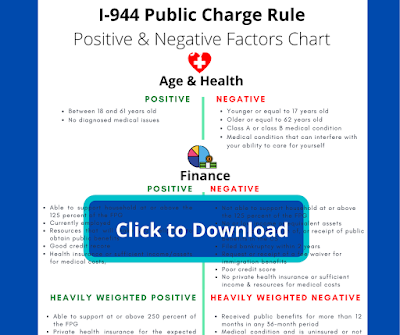
    What are the Positive Factors for Public Charge Rule?

    • Age: between 18 to 61
    • Health: no diagnosed medical condition
    • Finance:
    • Health insurance
    • Education & Skills:
      • Attended elementary, middle, and/or high school
      • Higher education such as Bachelor's Degree, Master's Degree, and/or Doctoral Degree
      • Professional skills and relevant certificates
      • English proficiency
      • Other language skills
    • Evidence of ineligibility for public benefits such as immigration status, or expected period of stay
    • Your sponsor(s) are your family members
    • Primary caregiver *

    What if I am just a Stay-home Mom?

    *I want to elaborate this factor a little more. Some of my readers are full-time moms and they don't have any work history. Note that being a primary caregiver of your kids is actually a positive factor! There are generally two groups of people in this category will be considered as a positive factor:
    • A stay-home parent who care for a newborn or young children in school.
    • A caregiver who cares for his or her elderly, ill, or disabled family members.
    However, it's important to know that USCIS also takes a lot of things into consideration such as
    • How old are the people/kids you take care of?
    • Do they live with you in the same residency?
    • Are they part of your household?
    • Are you the only caregiver to them?
    Remember to provide supporting evidence such as 
    • Medical record and reports
    • Your legal relationship with the person you take care of. 
    • Your kids' birth certificates (proof of age & relationship)

    What are the Negative Factors for Public Charge Rule?

    • Age 17 and younger or age 62 and older
    • Health: I-693 medical report lists
      •  Class A medical condition 
      •  Class B medical condition
      • Doctor indicates the health condition can interfere with the applicant's ability to care for him or herself (ex: to school or work)
    • Finance: 
    • No Health Insurance
    • Education & Skills:
      • No high school diploma, GED, or equalivant
      • No work history
      • No occupational skills
      • Don't speak English

    Step 2: Weigh all factors

    Now they will weigh all factors individually and cumulatively. One factor can be more heavily weighted (more important) than others. 

    What Positive Factors Weigh Heavier?

    • Your household assets, income, and resources are above 250% of the poverty guideline
    • Private health insurance for the expected period of admission
    • You are not receiving benefits under Affordable Care Act (ACA, also known as Obamacare) 
    • You have a work permit and are currently employed with an annual income above 250% of the poverty guideline

    What Negative Factors Weigh Heavier?

    • You received public benefits for more than 12 months in any 36 month period before the application for your green card ***Alert: USCIS no longer consider public benefit condition during COVID-19. (As long as the court order is in effect. This might change later on, check back again!) Learn more here.

    • You have a medical condition and are not insured or able to pay for the possible medical costs
    • You are not a full-time student and are authorized to work but you don't have recent employment history
    • You have previously been found inadmissible or deportable on the public charge ground 

    Step 3: Final Decision

    Finally, they will determine whether this applicant is likely or not likely to become a public charge at any time in the future. 
    • Not inadmissible: Positive factors outweigh the negative factors - You passed!
    • Inadmissible: Negative factors outweigh the positive factors - You didn't pass.
    Read to learn more:

    What are the Income Requirements for Form I-944 Declaration of Self-Sufficiency


    Form I-944 Declaration of Self-Efficiency is very similar to form I-864 Affidavit of Support, however, the I-944 looks at a wider range of factors including your education background, financial situation, language skills, employment history, health insurance, government benefits you have applied, etc.
    What are the income requirements for Form I-944?


    Out of all the factors, the income requirement is what most people concern the most, so I separate this into a dedicated post here to explain a little more. This rules are basically the same as the I-864 Affidavit of Support. Chances are if you can pass the I-864 requirements, you should be good for I-944's household income part.


    How to Apply for I-485 Adjustment of Status by Myself

    How much income do I need for form I-944?

    Form I-944 looks at your household income (including you, your spouse, and other family members if applicable). For most people, the household's annual income have to be at least 125% of the Federal Poverty Guidelines. This number changes based on your family size and location. Don't count any unborn babies (in case you are wondering!).
    Don't forget to include the most recent year tax return transcripts of all the family members whose income you are including in the form!

    • For a family of 2 persons in 48 contiguous states, the poverty guideline is $17,240 for 2020. So you are looking for at least $21,550 (125% of the poverty line)
    • For a family of 3 persons in 48 contiguous states, the poverty guideline is $21,720 for 2020. So you would need at least $27,150.

    Click here to find the most recent year guideline for your household size.

    What if I can't meet the income requirements?

    Don't give up without trying! Just like Form I-864, you can also include assets and other resources in Item 9. First find out your required household income number (see above) and calculate how much you are short. As a rule of thumb, you would need 5 times of the number you are short; however, if this application is just for a U.S. citizen's spouse or a child over 18 years old, you only need 3 times of the number you are short. Let's see a quick example:

    Your annual household income is $20,000 and the required income is $21,550, so you are short for $1,550 ($21,550-$20,000). Therefore your asset value has to be at least $7,750 (5 times the difference) or $4,650 (3 times the difference) if you are a spouse or a child over 18 of a US citizen.

    Read more: How to Overcome Public Charge I-944 Declaration of Self-Sufficiency

    What forms of assets are accepted in form I-944?

    There are many forms of assets accepted for I-944, usually the assets that you can quickly convert into cash. The common assets used include:
    • Houses you own
    • Checking and savings account
    • Annuities
    • Stocks and bonds/ certificates of deposit
    • Retirement accounts 
    • Educational accounts
    • Net cash value of your real estate
    • Other assets that can be easily converted into cash
    Remember to include a description of the asset, proof of ownership, cash value, and some other basic information.

    Click here to see my full I-485 application process>>


    *Disclaimer: I am not a lawyer or affiliate with any institutions. This post is just for sharing my person opinion and experience. 

    Will the Unemployment Benefit Jeopardize My Green Card Application?

    Since COVID-19 started back in March, the questions about whether getting unemployment benefits will jeopardize new green card applications and the renewals of other immigration status keep coming up. 

    Unemployment benefits and green card applications
    As you may know, USCIS now requires most applicants to submit a new form I-944 Declaration of Self-Efficiency which looks at our finance, education, and all benefits we have applied for to evaluate whether we can pass the public charge or not. So is unemployment going to be a red flag during the public charge review? Let's take a closer look:

    Is Unemployment a Red Flag to USCIS? 

    First you need to know what you are looking at. You can start by looking at your household income:

    What's your household income and who are your sponsors?

    If the unemployment lowers your "household" income, which makes you not able to meet the I-864 Affidavit of Support requirements, then yes, it can potentially lead to a rejection because of that.

    Read this post to learn more about I-864 requirements.

    Form I-864 and form I-944 both evaluate whether we have enough financial support, but it looks at your "whole household", which means, this includes your spouse's income and assets and it looks at how many minors you have, etc. Just you being unemployed is not the whole story. I would try to collect more positive factors to proof your self-efficiency other than your job.

    Unemployment is Not Welfare!

    Also note that unemployment is NOT welfare, it's an insurance that's funded by both employers and workers. The unemployment benefits are not at the cost of taxpayers, therefore it won't be considered as a negative factor in your form I-944 and it won't affect your pubic charge review. 

    I totally understand that COVID-19 pandemic can add a layer of difficulty to all of our I-485 adjustment of status applications, however, there's no need to panic! As long as you are following the rules and pass all requirements, there's no reason for USCIS to deny your case. 

    Click here to see a step-by-step experience for filing the I-485 application>>

    Disclaimer: This article is for sharing my personal opinion only and not for the purpose of providing legal advice.

    E-BOOK: My Marriage-Based Green Card Application Experience

    Many of my readers benefited from my blog posts and had asked me to put together this e-book. If you are one of us who are trying to apply for you or your spouse's green card by yourself, be sure to take advantage of my experience:)

    *Disclaimer:This e-book is meant for sharing my personal experience only and not for the purpose of providing legal advice. 

    I applied for my marriage-based I-485 AOS (green card) application by myself, so can you! My total expense for the whole process was around $1,800. My case was approved within 6 months. It took me about 2+ months to put everything together so I noted down all the details in hope of helping more others who may be in the same boat.

    *If you already paid for the templates, you can receive this ebook by just paying for the difference. Email chenevy99@gmail.com to submit your request today!
    E-BOOK: My Marriage-Based Green Card Application Experience

    What's Included in This E-Book?

    • Clear Step-by-Step Overview of Applying for Your I-485 Application 
    • Everything You Need to Know About in One File
    • Filing Tips to Save Money and Avoid Potential Rejections
    • Easily Printable PDF to Highlight and Review
    • A Typical Timeline and My Real Case Tracker
    • 7 Real Case Cover Letter Templates 
    • My Real Interview Experience
    • Frequently Asked Questions and Answers (from my real readers)
    • This E-Book is About 50 Pages!
    • NEW! A new assembling guide in a separate PDF file is included!

    *Disclaimer: This e-book is meant for sharing my personal experience only and not for the purpose of providing legal advice. 


    How to Include Assets for Form I-864 Affidavit of Support

    What forms of assets are accepted for I-864 Affidavit of Support

    How to Include Assets for Form I-864 Affidavit of Support

    If your household income is still below the requirement, you may use your assets. As a rule of thumb, the asset needs to be liquid, which means you can cash out quickly within 1 year without considerable hardship or financial loss to the owner. You have to include a description of the asset, proof of ownership, and the basis for the owner's claim of its net cash value.

    Some accepted forms of asset include:
    • Stocks, bonds, other security holdings
    • Real estate property
    • Saving or checking accounts

    If I include my assets, how much extra value in assets is enough?

    Generally, you need to have 5 times the income difference to meet the financial requirement. For example, if the sponsor's annual income is projected at $15,000 and the required income is $20,000. So you have $5,000 ($20,000-$15,000) income deficiency. Therefore, you would need 5x$5,000=$25,000 value in your assets to meet the threshold.

    There are some exceptions that only require 3 times the difference. Read the I-864 instruction for details. (on the top row of the instruction)

    Click here to see a step-by-step guide for filing the I-485 application.

    Disclaimer: This article is for sharing my personal experience only and not for the purpose of providing legal advice.

    DIY How I Applied for My I-485 Green Card with No RFE! (Updated May 2026, with New Requirements!)

    After all the trouble we have gone through preparing for my I-485 green card application for almost 2 months, I decided to put the things I have learned together and share with all of you who might be in the same boat and searching for a detailed, clear direction.

    Please note: This post is mainly for alien spouses applying for a green card through marriage to a U.S. citizen. If you are on K-1 visa, please click here to read a more specific guide.

    Disclaimer: This article is for sharing personal experience only and not for the purpose of providing legal advice. No guarantee of successful I-485 (green card) application results.
    DIY How I applied for my I-485 green card with no RFE!


    How to Apply for the I-485 AOS Green Card Step by Step 

    First, let me give you an overview of my I-485 application preparation. This article gets a little long, so please click the links below and fast forward to the section that you want to learn more details.

    Step 1: Download all the required forms and prepare 6 folders
    Step 2: Download all cover letter templates
    Step 3: Schedule a USCIS doctor's appointment - don't do this too late, you might have to wait in line
    Step 4: Fill out all forms - I suggest filling out the PDF files on your computer. It's easier to make changes. My suggested filling order is below. Click each link to go to that section for details.
    Step 5: Collect your sponsor's tax documents and asset evidence ( if needed) for I-864
    Step 6: Collect Bona-Fide evidence for I-130
    Step 7: Take passport-style photos
    Step 8: Assemble all forms and folders - check the filing tips before you do this step!
    Step 9: Choose your shipping carrier and check the shipping address
    Step 10: Review, SIGN and date each form
    Step 11: Final Review (Review all checklists)
    Step 12: Mail the package and wait for the great news! (Click here to see my real case timeline)
    Step 13: The Interview

    Purchase Your Assembling Guide Here for $10! (10 Steps to Assemble your I-485 AOS Application Package)

    New Update 7/16/2023: USCIS Self-Service Biometrics Appointment Rescheduling Tool

    How Long Does It Take To Receive My Permanent Residence (Green Card)?

     Here's a rough timeline I created based on my research to give you an idea:
    How long does it take to apply for a green card
    • 2 to 3 weeks after you mailed the I-485 application, you will receive your I-797 receipt notices (I received 4 notices for I-485, I-130, I-131, and I-765 respectively)
    • 3 to 5 weeks after you mailed the application, you will receive a notice for your Biometrics appointment
    • 5 to 8 weeks after you mailed the application, you will go to your Biometrics appointment (approximately 30 minutes) where they will take your fingerprints sample
    • 3 to 4 months after you mailed the application, you can expect to receive your EAD card with your travel document (on the same card) if you filed I-765 and I-131 concurrently
    • 4 to 10 months after you mailed the application, you will be notified for an immigration interview
    • 6 to 12 months after you mailed the application, you will go to your immigration interview (30 minutes to an hour). Some people reported that they received a verbal decision right after the interview. 
    •  8 to 14 months after you mailed the application, if everything is approved without RFE, you will receive your permanent residence (green card). Congratulations!
    Curious about my personal, real-case timeline? Click here to see!

    What forms do I need to submit for a family-based green card application?

    Here's an overview of the forms I submitted (original, old fee schedule):

    ***Updated 12/2/2024: if you are required to submit Form I-693, or a partial Form I-693 (such as the Vaccination Record), you must submit it with your Form I-485. 


    **Updated 4/4/2024: any Form I-693 that was properly completed and signed by a civil surgeon on or after Nov. 1, 2023, does not expire, and can be used indefinitely as evidence to show that the applicant is not inadmissible on health-related grounds.

    Also, the Form I-130 and Form I-693 can be submitted separately from From I-485 as well but they are required and are part of your I-485 application.

    Now, let's take a closer look at each form:

    Form I-485 Adjustment of Status Checklist

    Form I-485 is the main and most important form among all the forms required for a green card application.

    Form I-864 Affidavit of Support Checklist

    • I-864 Cover Letter
    • Form I-864 Affidavit of Support
    • Petitioner's most recent tax return documents
    • Evidence of assets (if applicable)
    • Evidence of beneficiary's current income (if you are using beneficiary's income)
    • Evidence of beneficiary's continuous income from a lawful source (if you are using beneficiary's income)
      • Beneficiary's employment verification letter
      • Beneficiary's W2s in recent years
    • Petitioner's passport copy
    • Petitioner's birth certificate copy
    • Marriage certificate copy
    • Other Supporting Documents - See more details in the cover letter

    Form I-944 Declaration of Self-Sufficiency Checklist

    • I-944 Cover Letter
    • Household’s most recent tax return documents and W2s
    • Beneficiary’s credit report
    • Beneficiary’s education diplomas (from high school to the highest level you have)
    • Beneficiary’s health insurance policy and/or other proofs
    • Beneficiary’s all public benefits (if applicable)
    • Beneficiary’s debts and liability (if applicable)
    • Household’s proof of assets & resources 
    • Other Supporting Documents -See cover letter for more details!
    * Many documents are repeating from I-864. In the instruction it states you don't need to provide repeating documents if already provided in I-864.

    Read More: How to Pass Public Charge I-944 Declaration of Self-Sufficiency>>

    Form I-130 Petition for Alien Relative Checklist

    • I-130 Cover Letter
    • 2 Passport style photos of petitioner
    • 2 Passport style photos of beneficiary
    • Form I-130 Petition for Alien Relative
    • Petitioner's birth certificate copy
    • Beneficiary's birth certificate copy
    • Petitioner's U.S. passport copy - make sure it's not expired
    • Beneficiary's passport copy - make sure it's not expired
    • Marriage certificate copy
    • Form I-130A Supplemental Information for Spouse Beneficiary 
    • Evidence of Bona-Fide Marriage (I separated this into another folder)
      • Cohabitation evidence: driver's license, any mail, letters from family/friends with both of your names on it, etc.
      • Lease or any contracts you both signed
    • Other supporting documents - See more details in the cover letter
    Click here to learn more about Bona-Fide marriage with example: What evidence of Bona-Fide marriage should I provide?

    Form I-765 Application for Employment Authorization Checklist


    Form I-131 Application for Travel Document Checklist


    I am asking for $10 for all templates, this will allow me to keep doing research and updates. Thank you for your support! See terms and conditions here.


    Pay by Venmo @Evy-Chen

    What Payment Methods Are Accepted by USCIS?


    Now USCIS accepts credit card payments! It's very convenient and you can save a few dollars by getting credit card bonuses. If you want to be more secure, a bank check is usually the safer way to submit your payment. See all payment options:
    • Bank Check
    • Money Order
    • G-1450 Credit Card Transaction - I chose this one and it worked without any issues!

    About Form I-864 Affidavit of Support

    Tax Return Documents for Form I-864

    The petitioner (U.S. citizen) is only required to provide the most recent year tax return document. However, you can choose to provide the most recent three year tax return documents if you think those will help prove your support.

    You can provide your IRS tax return forms along with your W2s, Form 1099, tax scheduled (for self-employed sponsors) OR IRS tax transcripts. You don't need both! You can get your IRS transcripts from IRS's website here. I think an IRS tax transcript is simpler with fewer pages, but it's really up to you.

    What is the requirement for I-864 Affidavit Support?

    According to the I-864 form instruction ( on the top row of the form), your household income has to be over 125% of the HHS poverty guideline. You can find the latest poverty guideline here.

    Depending on how many people in your household, the number will be different. In 2020, for a typical 2-people family, you need at least $21,550.

    What if my income is lower than the I-864 sponsorship requirement?

    If the petitioner (U.S citizen) doesn't have enough projected income to sponsor the beneficiary (alien spouse), you can choose to:
    All you need to do is include the alien spouse's information and income in form I-864 (page 4, part 6, number 8-10) and provide:
    • Evidence of your alien spouse's current income: You can provide your paycheck in the last 6 months, W2s, or tax return documents
    • Evidence to show that your alien spouse has continuous income from a lawful source: You can provide an employment certification letter from your employer, your VISA page copy, etc.

    Click here to read about: How to Include Assets for I-864 Affidavit of Support

    Who needs to fill out the I-864A form?

    When you have one or more co-sponsors other than your alien spouse (beneficiary), each of the co-sponsors has to fill out their own I-864A form.

    However, if you are using your alien spouse (beneficiary)'s current income as part of your household income, the alien spouse DOES NOT need to fill out the I-864A form. The only situation that he/she needs to fill out form I-864A is when he/she has derivative relatives who are applying for a green card with him/her.

    About Form I-765 Employment Authorization

    This form is pretty straight forward. Only a couple things that confused me a little:
    • Page 1, part I, question 1: Reason for Applying. Select "Initial permission to accept employment." if you are changing your H1B to a green card
    • Page 3, Part II, question 27: Eligibility Category. If you are applying to adjust your status from H1-B to a green card, you should fill in "c9" category here.

    About Form I-131 Travel Document

    This is also very straight forward. A couple tricky questions:
    • Page 3, part 4, reasons you can just say visiting family. If you are filing concurrently with I-485 like what I did, you don't need any evidence to support the reason. The agent will know this is because of the pending I-485 application.
    • Page 4, part 7, you would want to select "More than one trip" just in case you have to leave USA and come back multiple times. 

    About Form I-693 Report of Medical Examination & Vaccination Record


    **New Update: Any Form I-693, Report of Immigration Medical Examination and Vaccination Record, that was properly completed and signed by a civil surgeon on or after Nov. 1, 2023, does not expire and can be used indefinitely. Learn more here>>

     Where do I find a green card immigration doctor?

    You will need a qualified immigration doctor to help you fill out most of your I-693 report of medical exam and vaccination record. Go to USCIS's website to search for a listed doctor that's convenient for you. Each doctor charges differently, so I suggest you call at least 3 to compare the prices. Note that a lot of immigration doctors only take cash or check.

    If you already have done some of the required vaccinations or blood test, be sure to bring them with you to the doctor's appointment. You may be able to save some redundant vaccination shots!

    Download my ebook to learn more filing tips and avoid simple mistakes!

    Here's a  list of questions you will want to confirm before you go to the immigration doctor:
    • How much do you charge for the basic exam?
    • Do you accept a credit card payment?
    • Do you accept a FSA/HSA/HRA card?
    • How much do you charge for the shots and blood tests if I need them?
    • Do you accept the vaccination records and blood test results from somewhere else?
    • How long does it take to get the I-693 report?

    Click here to read more about: What vaccines and tests are required for the I-485 green card application?

    What if I am pregnant? Can I still pass the exam? Click below to read more:

    Click here to read more about: How long does it take to receive my I-693 report?

    About Assembling and Packing I-485 Application (Concurrent Filing with Form I-130, I-765, and I-131)

    How many G-1145 forms and cover letters should I include in my I-485 application package?

    As per my research online, some people have just one G-1145 form for the whole package, some people have one G-1145 for each separate application form. Same for the cover letters - You can have one main cover letter with a long itemized list or have separate cover letters for each application form. 

    What did I do? I think it doesn't hurt to have separate forms and cover letters and it is clearer that way, so I submitted these cover letters and G-1145 forms:
    Generally, you will need at least 8 head-shot photos of the beneficiary (alien spouse) and 2 head-shot photos of the petitioner (U.S. citizen spouse) for the whole concurrent filing package.

    Here's the breakdown:
    • 2 photos of alien spouse for I-485
    • 2 photos of alien spouse for I-130
    • 2 photos of U.S. citizen spouse for I-130
    • 2 photos of alien spouse for I-765
    • 2 photos of alien spouse for I-131


    *Now USCIS combines I-765 and I-131 together (work permit and travel document) so 6 photos is acceptable. See more details here.

    Click here to see more details about: How to organize and assemble my I-485 concurrent filing package

    Purchase Your Assembling Guide Here for $10! (10 Steps to Assemble your I-485 AOS Application Package)

    Where do I mail my I-485 Package?

    Depending on how you file your package, concurrent or I-485 only and which shipping carrier you are using, your filing address will be different. You can find the filing address guideline here on the USCIS's website. I filed concurrently with form I-130 by USPS so my address was:

    USCIS Chicago Lockbox
    For U.S. Postal Service (USPS):
    USCIS
    PO Box 805887
    Chicago, IL 60680-4120

    *Jan. 8th, 2021 Update: USCIS has updated Form I-485 filing locations. See here for more details.

    What shipping carriers are accepted by USCIS?

    USCIS accepts USPS, FedEx, UPS, and DHL deliveries. After comparing multiple carriers, I decided to go with USPS Medium Primary Mail which costed me $13.65 at the time and the package arrived in 2 days. The price changes over time, the Medium Priority Mail rate is now $14.35. Check the latest USPS package rates here.

    Final Review for the I-485 Application (Concurrent Filing)

    Before you submit your whole I-485 package, be sure to review your application again! Here's a list of my last-minute review that will help you avoid making stupid mistakes:
    See a full final review list and more filing tips in my e-book that will help you avoid mistakes!

    My I-485 Concurrent Filing Application Timeline:

    • 1/26  Mailed the I-485 Application Package
    • 1/28  Package Delivered to Chicago PO Box
    • 2/1 Credit Card Payment Pending Showed Up
    • 2/3 Credit Card Payment Completed
    • 2/4 Received 3 Text Message Notices (there's supposed to be 4 notices, but 1 was missing for some reason)
    • 2/7 Received Four I-797 Receipt of Notices in the mail
    • 2/9 Received I797C Biometrics Appointment Notice in the mail
    • 2/22 3 pm Had my fingerprints and picture taken at the biometrics appointment
    • 2/26 Case Status changed to "case is ready to be scheduled for an interview".
    • 5/29 Interview was scheduled!
    • 6/4 Received the interview notice in mail 
    • 7/8 Completed the interview - see my interview experience here!
    • 7/8 I-485 status changed to "New card is being produced"
    • 7/8 I-130 status changed to "Interview was completed and my case must be reviewed"
    • 7/11 I-485 status changed to "Card Was Mailed to Me"
    • 7/12 Received I-485 & I-130 Approval Notices
    • 7/12 Card Was Picked Up By The United States Postal Service (with tracking number)
    • 7/15 Received an official green card!
    My employment authorization and travel permit applications are both still pending even after the I-485 was approved. 

    I hope this article helps you prepare for your I-485 application. If you have any questions, feel free to leave a comment below for a discussion or share your experience with all of us! Good luck!

    Disclaimer: This article is for sharing personal experience only and not for the purpose of providing legal advice.

    If you like my post, don't forget to share out to more people so I will be able to create more useful posts in the future!:) Thank you!

    Questions?

    Name

    Email *

    Message *